

Most people never see the thing coffee actually comes from. Which is a shame, because it explains almost everything about how coffee tastes.
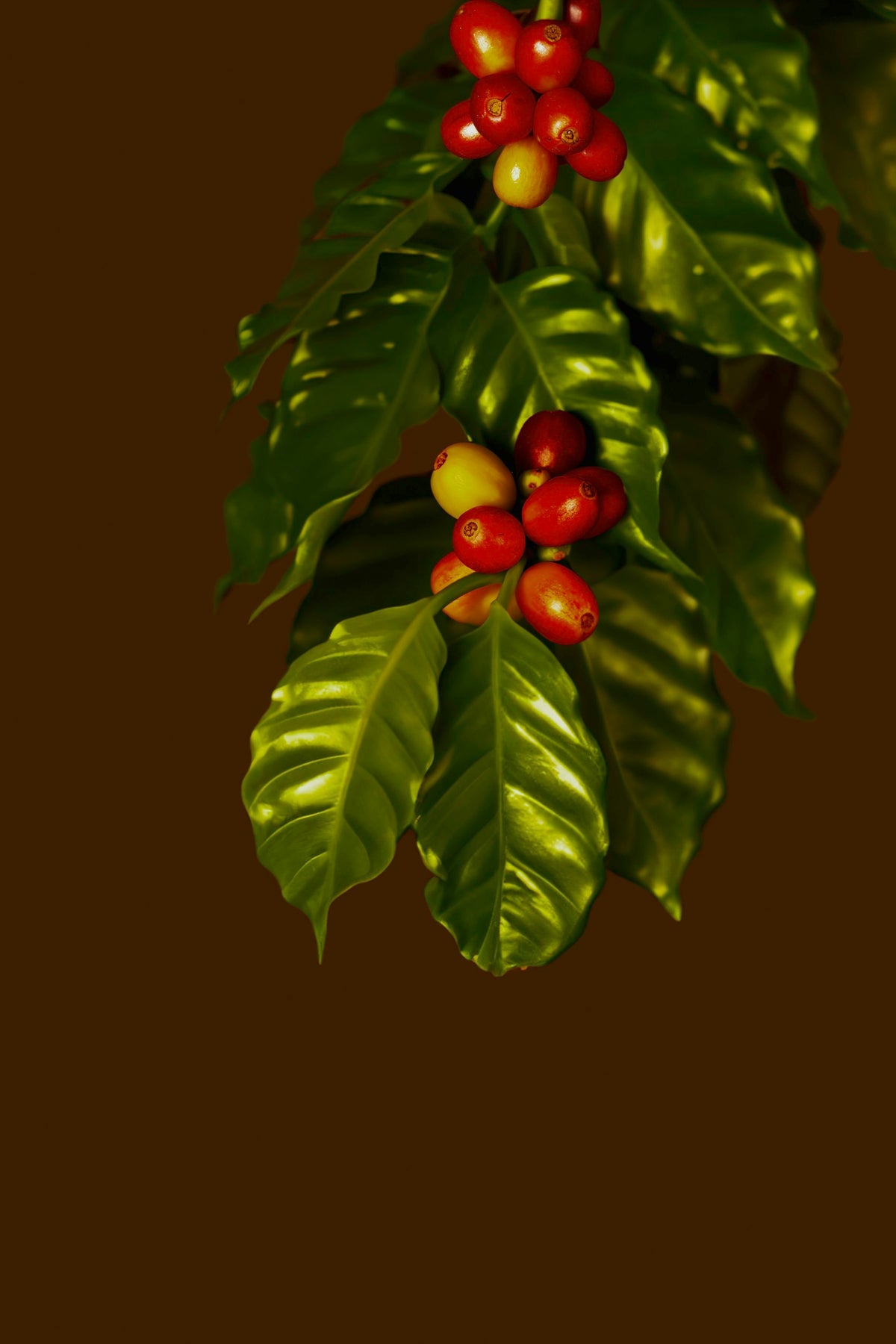
Coffee is the seed of a fruit. A small red cherry that grows on a shrub in the tropics. Every bean in your bag started life inside one.
Every coffee bean grew inside a cherry
A coffee cherry is about the size of a cranberry. Under the skin sits a thin layer of sweet, sticky fruit. Under that, a papery shell called parchment. And inside the parchment, the seeds.
Usually there are two, pressed flat side to flat side. That's why a coffee bean has one flat face with a line running down the middle.
Around 5–10% of cherries grow a single, round seed instead. That's called a peaberry.
Coffee grows in a narrow band around the equator
Coffee grows in what's called the coffee belt, roughly between the Tropics of Cancer and Capricorn. Ethiopia, Kenya, Colombia, Guatemala, Costa Rica, Brazil.
Arabica, the species almost all specialty coffee comes from, prefers altitude. Often between 1,200 and 2,200 metres, where cooler nights slow the cherry down and give it more time to build sugar.
A coffee plant needs three to four years before it fruits. After flowering, the cherries take around seven to nine months to ripen. On most specialty farms they're picked by hand, because cherries on the same branch don't ripen at the same time.
What happens to the fruit shapes the flavour
Once picked, the seed has to come out of the cherry and be dried. That step is called processing, and it's one of the biggest flavour decisions in coffee.
Washed: the fruit is removed before drying. Cleaner, brighter, more transparent.
Natural: the whole cherry dries around the seed. Fruitier, heavier body.
Honey: some of the fruit stays on. A middle ground, often very sweet.
You can taste this on our shelf. The Ethiopia Filter is a natural, which is why it tastes so openly of raspberry. The Kenya Filter is washed: jasmine, grapefruit, a sharper and cleaner cup.
Green coffee still needs roasting
After drying, the parchment is hulled off. What's left is green coffee: hard, pale, and smelling of hay. You can't brew anything good from it yet.
Roasting is what turns that seed into something that tastes like chocolate or berries. We work with a roasting partner for that part, and spend our own time choosing, tasting and brewing.
Why this matters in your cup
Coffee isn't a generic bean. It's agriculture. Ripeness, altitude, variety and processing all show up in the cup.
When a bag says raspberry or brown sugar, nothing has been added. That's the fruit, the farm and the way it was handled after picking.
Next time you brew, smell the grounds before the water goes in. Somewhere in there is a cherry.


